
Criminal Court Cases in Surry County
The North Carolina Judicial Branch Surry County hub places the county's District Court, Superior Court, and Prosecutorial District in District 23. One Clerk of Superior Court maintains the criminal files for both trial divisions. District Court decides misdemeanors and handles early felony steps, including probable-cause proceedings. Superior Court decides felonies and hears misdemeanor appeals through a new trial, known as trial de novo. This unified structure matters. A searcher does not need to choose between separate county and district clerks, but does need to know which division handled the stage or outcome being reviewed.
The clerk file follows the charge after it enters court. It can show the charging paper, hearings, pleas, motions, charge-level disposition, judgment, sentence, and court costs. That is different from a Surry County arrest or booking entry. Booking proves that custody processing occurred. Only the court's disposition establishes whether the filed charge ended in conviction, dismissal, acquittal, or another result. The broader Surry County criminal history overview explains how court, jail, police, and fingerprint records fit together.
The official county court-services page shows the local route into that system.
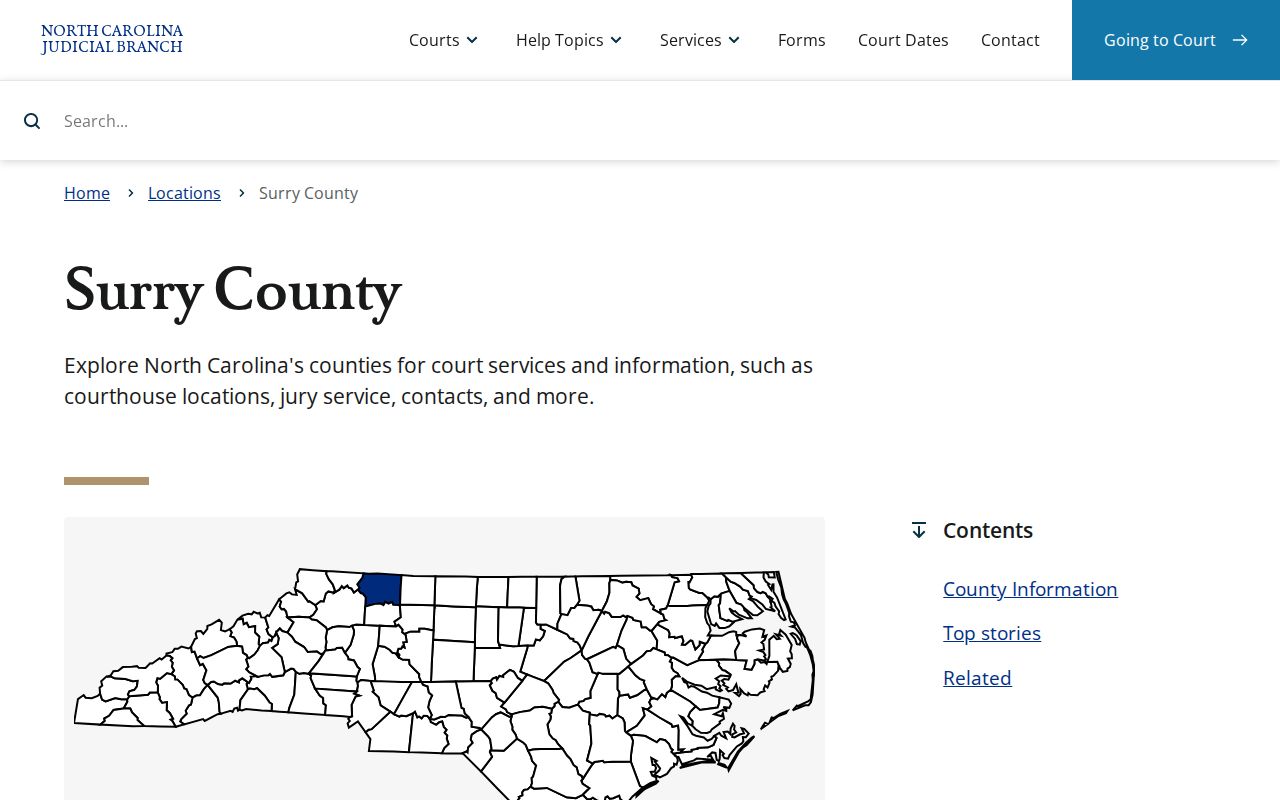
Its service links help separate case searches, court dates, forms, payments, and direct clerk help.
Surry County Court Divisions Compared
Offense class points to the trial division, yet a felony may appear in District Court before it reaches Superior Court. North Carolina uses lettered felony classes and misdemeanor classes. Class alone does not set one fixed penalty. Prior-record level, offense date, findings, and the applicable structured-sentencing chart also affect punishment. Portal labels should therefore be read with the filed charge and judgment, not used to guess a sentence.
| Local court | Main criminal work | Record clue |
|---|---|---|
| District Court | Misdemeanors and early felony proceedings | Initial settings, probable-cause steps, and misdemeanor judgments |
| Superior Court | Felony trials and misdemeanor appeals | Indictments, felony pleas or trials, and final judgments |
| Magistrate | Criminal process and initial release matters | Warrants, first appearance, and bond information may lead into the case |
The District Attorney reviews law-enforcement submissions and selects the charge that proceeds for the State. That is why an arrest label can differ from the charge filed in Surry County court. District 23's Dobson prosecution office is reached at 336-386-3710. Clerk staff can locate records and explain filing procedure, but they cannot provide legal advice.
Surry County Case Record Searches
The North Carolina eCourts Portal is the main remote channel for public Surry County criminal case data. Choose Smart Search and enter an exact case number when one is known. Otherwise use a name, select Surry County, and narrow the result set by criminal case type, status, or filing dates when those filters appear. Match more than a name. Filed date, charge, court location, and other public attributes help prevent two people with the same name from being merged in error.
- Use the full case number first. If searching a person, Portal wildcard rules require at least three last-name characters plus an asterisk and one first-name character plus an asterisk.
- Set Location to Surry County and apply criminal, status, or date filters. Advanced Filtering is useful because broad results can stop at 200.
- Open the case summary and read every charge-level disposition. A case marked disposed does not by itself mean every count produced a conviction.
- Check hearings and the Register of Actions for the sequence. Use the separate court-date tool for the next setting, not as a substitute for the case file.
- Call or visit the clerk when a converted case lacks an image, when an older file is thin online, or when a certified paper is required.
| Portal field | Use | Search note |
|---|---|---|
| Search Criteria | Name or case number | Record Number or Name is the default Smart Search |
| Location | County filter | Select Surry to reduce statewide same-name results |
| Case Type | Category filter | Choose a criminal or infraction category when offered |
| Case Status | Active or disposed | Read charge details before drawing a conclusion |
| Date Filed | From and to dates | Narrows common names and long result lists |
Portal case numbers follow the statewide Enterprise Justice pattern, with a two-digit year, case-type letters, a six-digit sequence, and a three-digit county identifier. Public dates of birth are masked. If the exact case number is unavailable, use a narrow name search and compare several public facts before selecting a Surry County result.
Surry County's eCourts Conversion
Surry County joined eCourts Track 9 on July 21, 2025, with thirteen other North Carolina counties. The change brought electronic filing and public Portal searching into the county's normal court workflow. The Judicial Branch eCourts overview describes the statewide system and its public access tools. Portal data can include case summary, parties, assignments, events, dispositions, hearings, the Register of Actions, and financial information. Public birth dates are masked, and sealed or sensitive documents are not exposed.
Conversion did not make every old paper image appear online. A migrated Surry County case may show an event or document title without a downloadable image. That does not prove the filing is missing. Record depth can vary by the source system and by document security. Ask the Dobson clerk to inspect the file, using the case number if possible. The clerk can explain copy and certification options for material that remains public.
The official eCourts information page captures the system that now supports local electronic records.
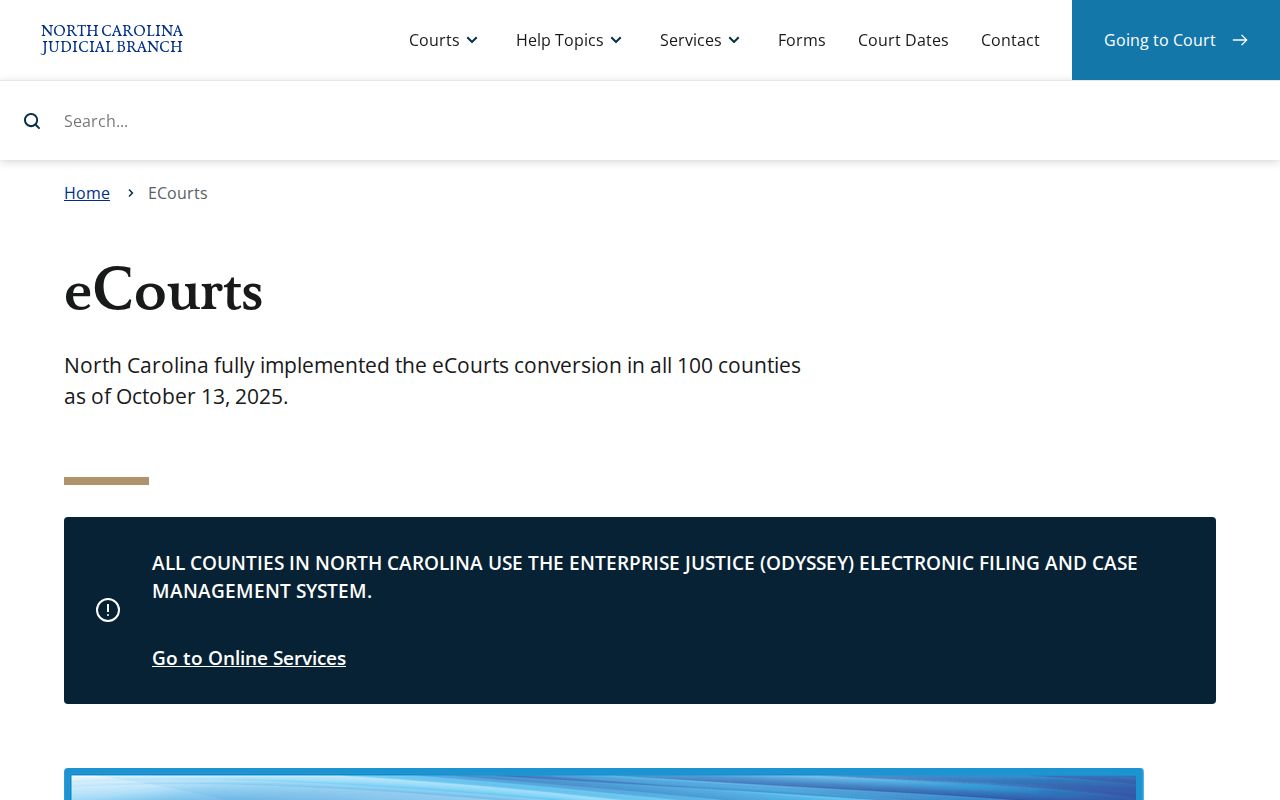
Note: The statewide platform expands remote access, but an absent image does not prove the underlying Surry County court filing is missing.
What a Criminal Case File Contains
A Surry County criminal file is organized around a case and its counts. Availability varies with the person's role, document security, and the conversion history. Public data can still provide a detailed procedural trail, including filed dates, counsel entries, hearings, charge text, and the outcome of each count. It may also show bond information, financial assessments, and sentence terms recorded in the judgment.
| Case header | Case number, style, Surry County location, court division, type, filing date, and status |
|---|---|
| Parties and counsel | The State, defendant, and public counsel entries where available |
| Charges | Description, statute, offense class, offense date, and disposition for each count |
| Docket events | Filings, process, appearances, continuances, pleas, hearings, and judgment entries |
| Hearings | Date, time, location, type, and sometimes the assigned judge |
| Judgment | Disposition, active or community punishment, confinement, probation, and conditions as recorded |
| Financial record | Costs, fines, restitution, balance, and payment events where public |
Protected identifiers, confidential reports, victim or minor data, juvenile matters, and sealed or expunged content can be omitted or redacted. Remote public access can also be narrower than supervised inspection at the clerk's office. A screen print is useful for orientation. It is not the same as a certified judgment.
Certified Surry County Court Records
For one known Surry County case, ask the clerk for the specific public judgment, order, or docket item and whether certification is available. For a certified statewide court-index search, use the official AOC-CR-314 request. That product costs $25 and searches the Judicial Branch statewide criminal case index. It is not an SBI fingerprint record and is not the same as buying one case copy.
Surry's payment instructions say mailed payments may use a money order or certified check, but not cash or a personal check. In-person court payments can use cash, major cards subject to processing fees, money order, or certified check. Confirm the current payment method for a record request before sending it. A person reviewing their own full North Carolina fingerprint history must instead use the SBI Right to Review process.
Surry County Clerk of Superior Court
201 E. Kapp St.
Dobson, NC 27017
Mail: P.O. Box 345
336-386-3700
Monday through Friday, 8:00 a.m. to 5:00 p.m.
The official courthouse page confirms the access point and visitor details.
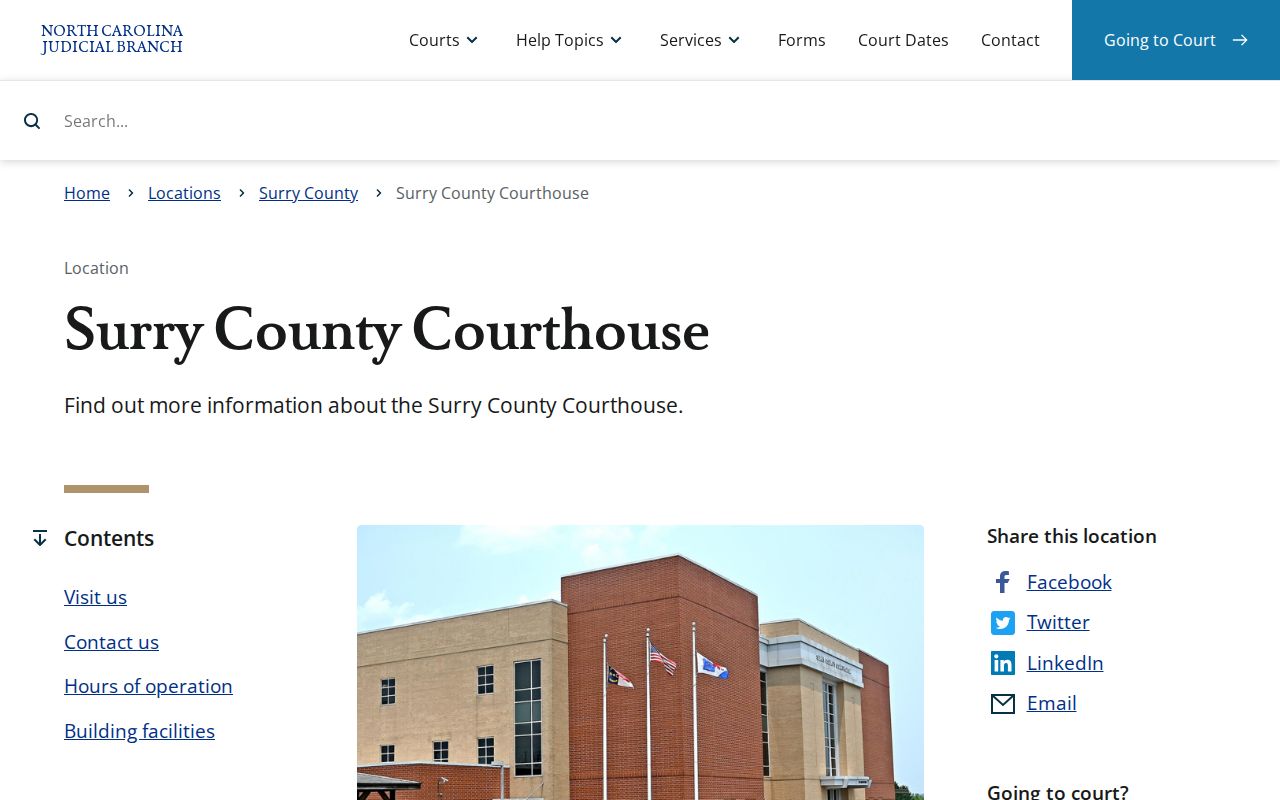
The Dobson courthouse remains the direct fallback for certified records and public material not fully shown in Portal.
Criminal Case Stages in Surry County
A filed Surry County case changes as the prosecutor and court act. Charges can be amended, dismissed, or resolved separately. A felony may begin with District Court proceedings before an indictment supports Superior Court prosecution. A plea or verdict addresses guilt, while judgment states the court's sentence. Continuances and calendar settings are procedural events, not new charges or convictions.
Case flow: Charges Filed › Arraignment › Pretrial › Plea or Trial › Disposition › Sentencing
- Arraignment
- The point at which charges are formally addressed and a plea may be entered.
- Disposition
- The outcome or present resolution of one charge.
- Judgment
- The court's formal disposition and sentence.
- Trial de novo
- A new Superior Court trial following a misdemeanor appeal from District Court.
A fingerprint repository record may lag behind the court outcome because the SBI must link the reported disposition back to the arrest cycle. For the legal result, use the Surry County judgment and charge-level disposition.
Reading Surry County Criminal Calendars
The Surry County local administrative schedules separate Superior Court settings into administrative, attorney, plea, plea-and-motions, and trial calendars. Those words describe the purpose of a session. They do not prove a case reached trial or ended on that date. A matter may move through more than one administrative setting before a plea or trial calendar.
Use a calendar to confirm when and where a current matter is set. Then return to Portal or the clerk file for procedural history and the final result. The court-date search is a schedule tool, not a full historical docket.
The official calendar choices show how Surry County sorts criminal sessions.
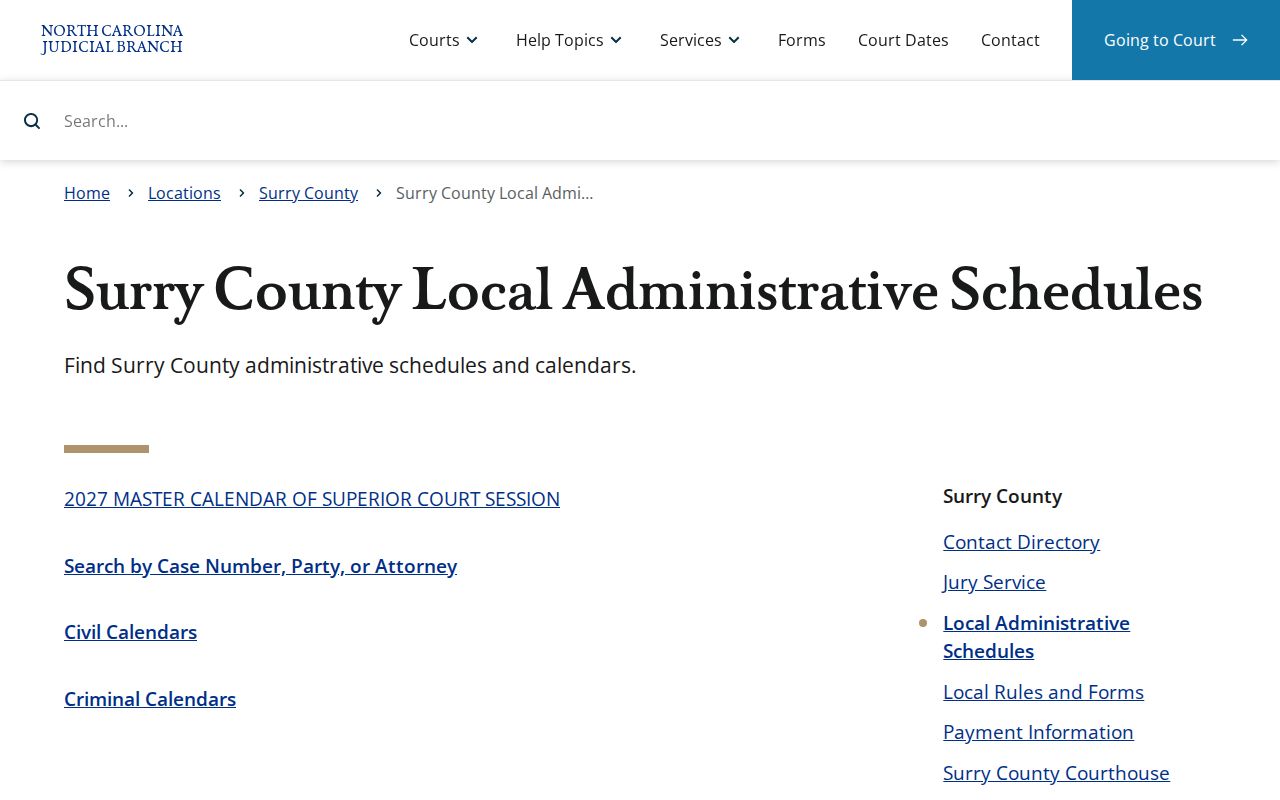
Reading the calendar label with the docket prevents a routine setting from being mistaken for a trial or conviction.
Surry County Filed Charges Explained
An officer records the suspected offense at arrest. District 23 prosecutors then review the submission and decide what charge proceeds in court. The filed charge may be narrower, broader, or different from the booking label. Later, the charge-level disposition can differ again because a count was dismissed, amended, resolved by plea, or tried. None of these changes makes the earlier record false. Each reflects a different stage and custodian.
When records conflict, write down the case number, arresting agency, arrest date, filed count, and judgment. Do not force unlike labels into one field. The clerk case controls the court result, while the arresting agency remains the source of its report and the jail remains the source of booking facts.
The official Surry court contact directory separates the clerk, prosecutor, judges, and magistrates.
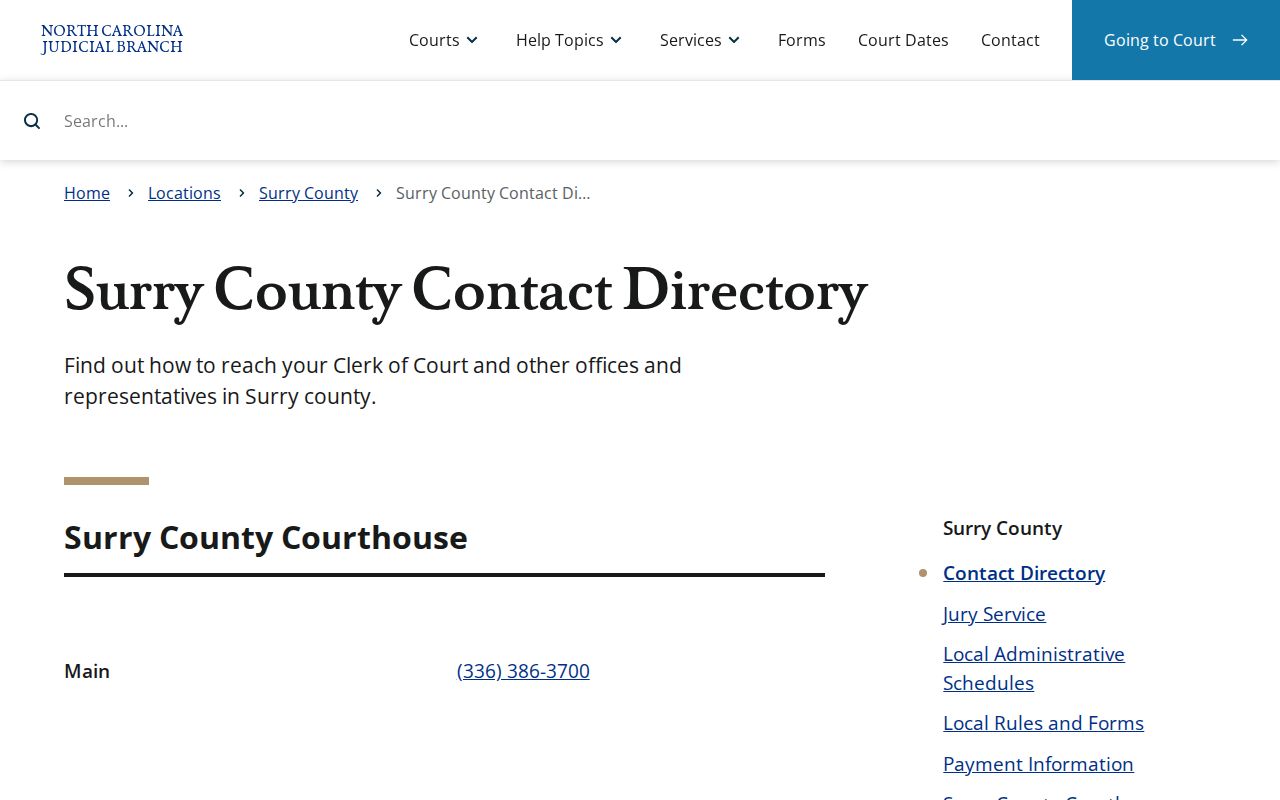
That division of roles helps a reader direct a record question to its actual custodian.
Access Rules for Case Records
North Carolina G.S. 7A-109 generally permits inspection of clerk-maintained records under the clerk's supervision, subject to law and reasonable rules. Public access does not expose every field. Juvenile records, sealed or expunged cases, protected victim or minor information, confidential reports, and sensitive identifiers can be withheld or redacted. Portal also blocks documents that are not eligible for remote public viewing.
If a Surry County case does not appear, check the spelling and location filters, then ask the clerk about older conversion data or restricted access. Clerk staff can state whether a public record exists and how to request it, but cannot disclose sealed content. For police narratives or jail booking material, contact the creating agency instead. North Carolina Public Records Law does not turn a law-enforcement investigative file into a clerk case file.
Access point: Online search is free, while certification and copies may carry fees. Confirm the record, format, and current charge with the clerk.
Note: Verify identity with several public case attributes before treating two Surry County results as the same person.